Jefta van Dinther on Dark Field Analysis
In Dark Field Analysis, love, science and existential introspection meet. Two naked men lie on a mat, surrounded by the audience, and talk about the secrets of blood. The title, taken from the dark field microscope analysis, becomes a gateway to the interior: a look into the body, into the living, shaped by both aesthetic beauty and physical presence. In an interview produced by the Centre Pompidou for their YouTube channel, Jefta van Dinther talks about his approaches to the work.
Seeing your own blood in real time, in motion, under a microscope - it's both clinical and poetic. When Jefta van Dinther had a dark field analysis done, he experienced it as an existential moment: a look into the body, but also at the body, a reminder of the inescapable materiality of life. In the meeting between scientific method and subjective experience, the title of the work was born Dark Field Analysis.
- "Looking at the blood in that way was like being inside your own body and an outside observer at the same time," he says in the interview.
It was both alien and deeply moving - like diving into oneself. From that experience grew not only the title, but also the theme. As the work progressed, he and the dancers decided, Mr Juan Pablo Cámara and Roger Sala Reyner, who also co-created the work, that the conversation on stage would always revolve around blood - as a concrete metaphor for the most human, but also for the alien and unknown within us. The process was particularly coloured by the fact that the doctor performing the dark field analysis was a man van Dinther fell in love with.
- Being a patient and a lover at the same time was an experience that characterised both that period of my life and the direction of the project," he says.
The body as a meeting place
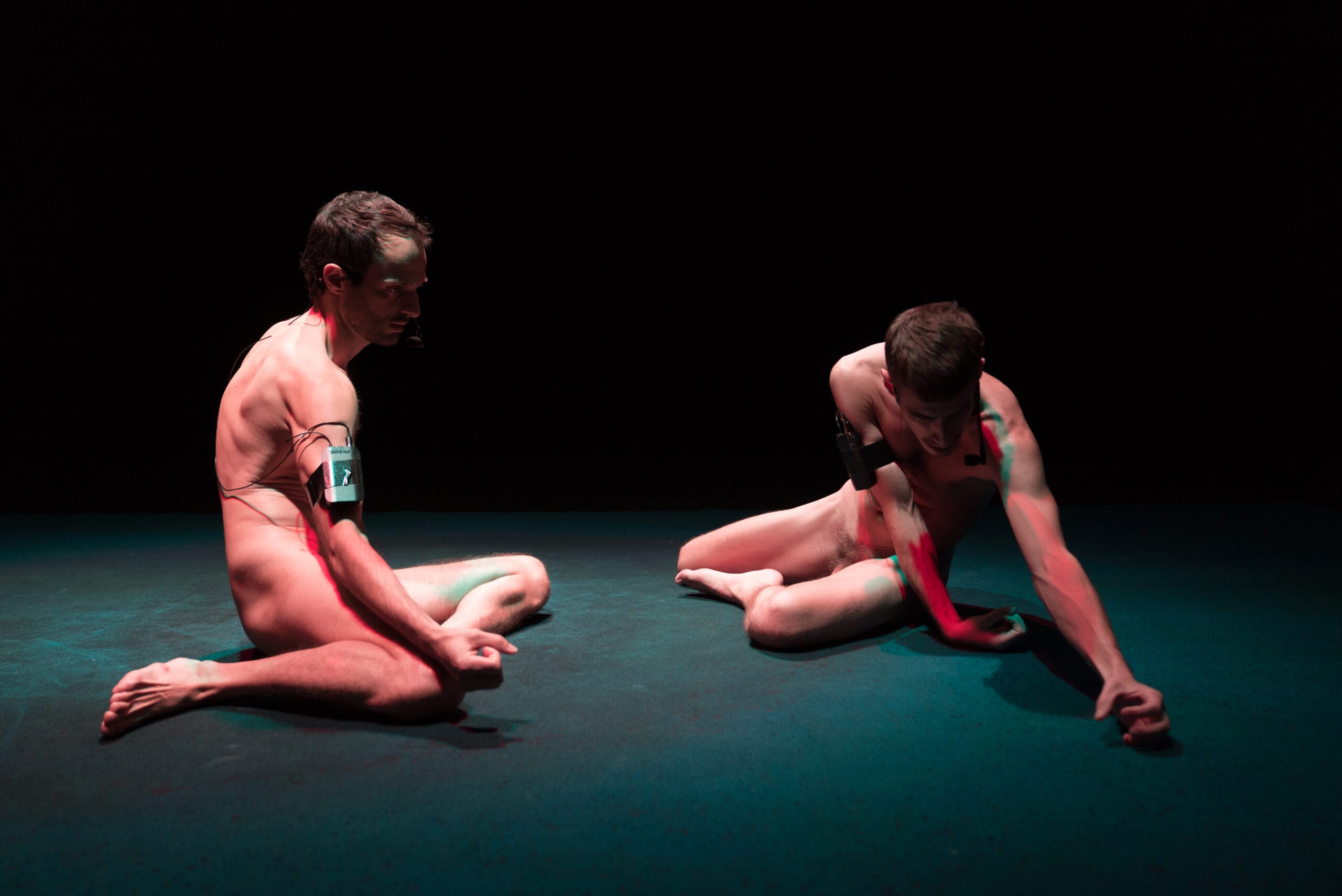
But blood was only one of the inputs. At least as crucial was the idea of encounter - the meeting. What happens when two people are not just seen, but actually meet? On stage, two naked men sit on a carpet, surrounded by the audience. They talk to each other, but equally to each other's bodies and movements. The words emerge from conversations about life, mortality and desire. Gradually, a contrast emerges between the two figures - their characteristics become as important as their interaction.
The work does not seek a linear progression, from one state to another. Rather, it weaves together different forms of being: the human and the animal, the organic and the artificial, the vulnerable and the powerful, the intimate and the alien. The audience is drawn into this cycle and becomes a witness to something that is both a dialogue and a choreography.
Everything is choreography
Van Dinther describes how the process of working on the work gradually opened up to more layers.
- We soon realised that everything is choreography: the movement, the text, the light, the sound. Even the voice became something more than words - it became song. The soundscape is based on two simple repetitive songs taken from PJ Harvey, which, together with the voices of the dancers, create a hypnotic, almost trance-like flow. The sound acts as a pulse, reminiscent of the beating of the heart, while the light shapes the space into something resembling an anatomical theatre. Here, the viewer becomes as much a part of the work as the viewed.
Inside the body
Although there is no blood on stage, it is present everywhere: in the language, in the light, in the colours. The audience can eventually feel that they are inside a body - in a living body space where shapes and colours spill over, rub off and dissolve into each other. It creates an atmosphere where you constantly oscillate between understanding and getting lost.
The work never reaches an end point. It does not lead from the human to something else, but allows different states of being to coexist and to strain against each other. Getting lost here is not a failure, but a method - a way of facing what one did not know about the world, or about oneself.
It's about taking a closer look, a deeper look. And at that moment, it no longer becomes science. It becomes experience, internally.