The blackest of the black
The blackest black. A rarely seen deep-sea jellyfish. And an AI-controlled music system. Wayne McGregor's performance Deepastaria contains many special and somewhat unusual ingredients. We took a closer look at three of them and found connections to both Jacques-Yves Cousteau and a British art dispute.
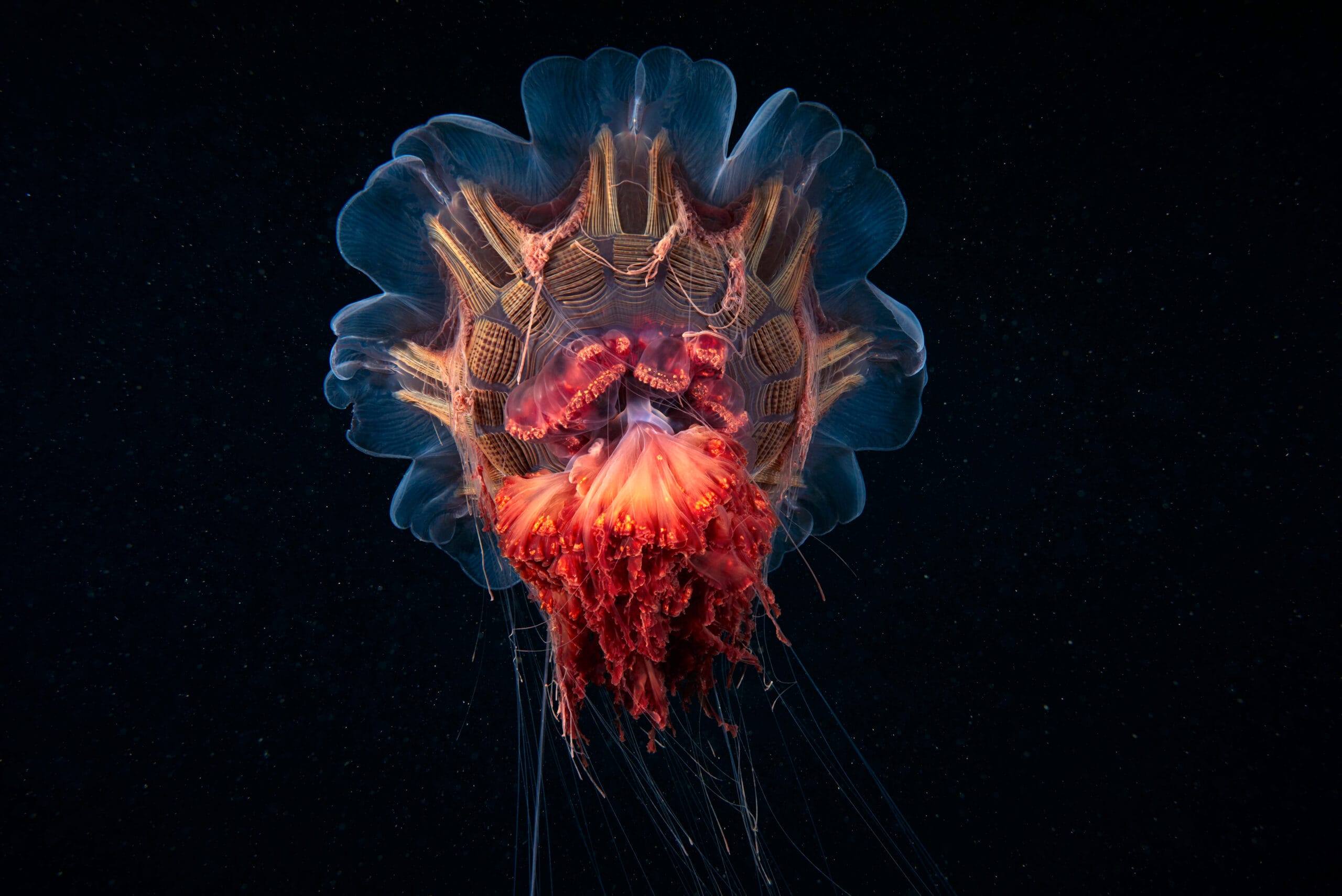
Deepstaria jellyfish. Like a delicate, almost paper-thin lampshade, it floats through the sea – the Deepstaria enigmatica jellyfish. It got its name from the underwater vehicle that discovered it in the 1960s: Deep Star 4000, a submarine developed by the legendary Frenchman Jacques-Yves Cousteau, filmmaker, diver, oceanographer and director.
The Deepstaria jellyfish lives in the deep seas, in or around Antarctica, but it has also been spotted in waters around the United Kingdom and in the Gulf of Mexico. To see it, you need to dive deep. Deepstaria usually lives at depths of 800–1,800 metres.
Two things distinguish Deepstaria from most other jellyfish relatives: they usually live alone, which is unusual among jellyfish that often occur in groups, and they lack tentacles or threads. They are also unusually large and can reach a diameter of 60 centimetres.
Vantablack – the blackest black ever made
Does it feel like the stage in Deepstaria has no end? Like you're almost sinking into the stage space. You're not crazy! Parts of the set design in the performance use Vantablack technology. Vantablack is one of the blackest substances in the world, absorbing almost 100 per cent of all light. It's wrong to call it a colour because the material is actually a dense forest of many, extremely small, hollow tubes – each one the size of a single atom.
Why, then, does the surface appear so bottomlessly black?
To put it simply, the light that hits the surface seeps in between the tiny tubes, bounces around until it is completely absorbed, and then disappears. The material is so black that objects in Vantablack lose all three-dimensional features. Even if you bend the material, it still looks flat.
The material was developed in the early 2010s by the British company Surrey NanoSystems and has been used in the space sector and the defence industry, among others. In 2019, car manufacturer BMW produced a single, unique model of a car with a paint finish made from Vantablack. An exclusive Swiss watch brand has also produced a model using the material. Interested in buying one? If you have £70,000 to spare, it could be yours!
In the mid-2010s, Vantablack became the subject of a high-profile and heated art dispute. British artist Anish Kapour purchased the exclusive rights to use Vantablack for artistic purposes. Several artists felt that no one could own an artistic material. Among others, Kapoor's British colleague Stuart Semple countered by producing ”The Pinkest Pink”.
Bronze AI
In Deepstaria, composer Nicolas Becker uses a digital sound engine called Bronze AI – software that allows users to employ AI models to create a soundtrack that is continuously recomposed during the performance, in real time. This means that the soundtrack for each performance is unique.