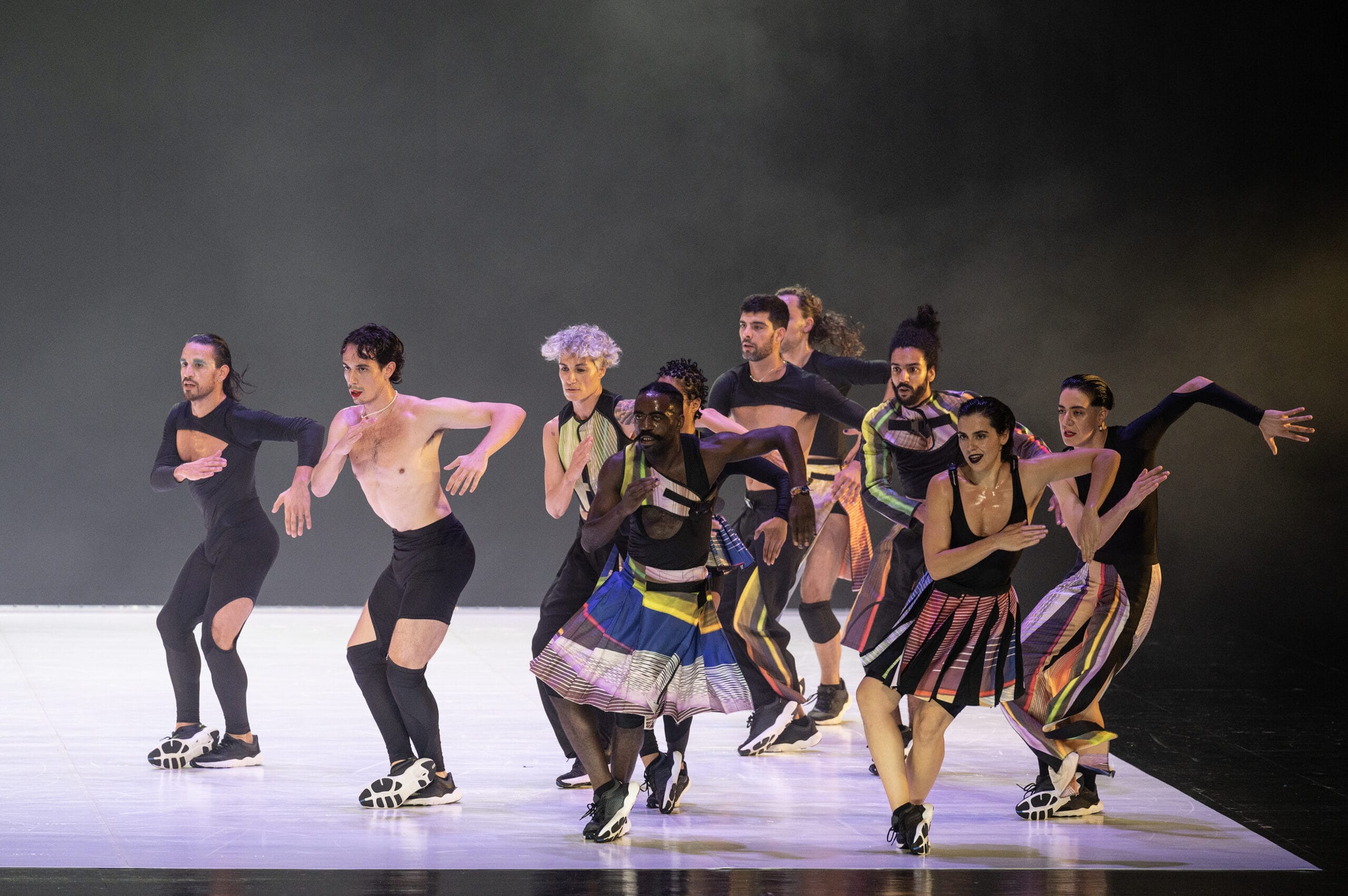
Marco da Silva Ferreira (PRT)
Carcaça
4 October 2025
Programme
A mesmerising and subversive confrontation where the traditional collides with the contemporary.
TicketsDuration
75 minutes
4 Oct
19:00
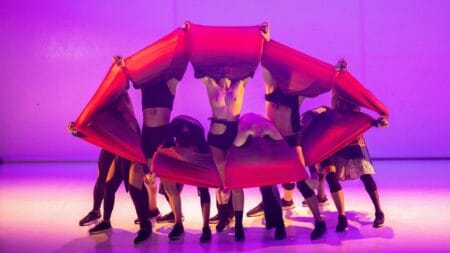
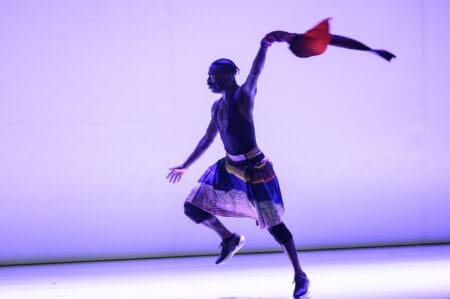
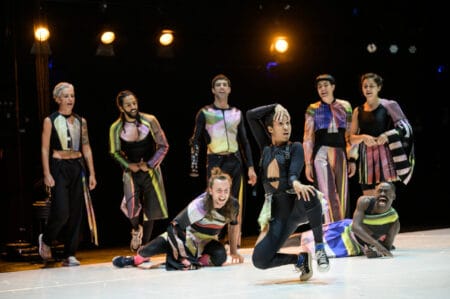
The tempo gradually increases and accelerates to 145 bpm as ten dancers engage in energetic and intricate footwork under Marco da Silva Ferreira's choreography. With a dance style that can be characterised as a kind of hybrid between urban styles and folkloric dance traditions, an eclectic, powerful and rhythmically intense performance is created. The dancers' bodies unite in a vibrant, intuitive and carnivalesque wave of movement. Carcaça Marco da Silva Ferreira uses dance as a tool to explore the collective identities of marginalised groups, with specific references to house, kuduro, top rock and hard rock. Through this approach, the work moves between past, present, folklore and urban culture and seems to invite the viewer to reflect. What role do individual identities play in building a community? What world crosses the individual and collective body? Or rather, which bodies cross the world?
The intense and complex footwork of the dancers wearing trainers not only brings sound to the stage, but also creates warmth and energy of movement in the space. Musically, the dancers are accompanied by drums played by João Pais Filipe and electronic music by Luís Pestana, with a soundtrack that runs through the performance with references from traditional, postmodern and club music. Carcaça (which means corpse, cadaver or skeleton in Portuguese) is a work anchored in the present and focused on the future - rooted in the past.

About Marco da Silva Ferreira
With only a handful of his own choreographic works, Marco da Silva Ferreira has quickly become recognised as one of Portugal's leading choreographers. His distinctive dance style, often enhanced by movement practices borrowed from club culture, street and ballroom, creates complex and pluralistic works. Ferreira sharpened the audience's gaze through an absolute presence in his works, in which social and societal norms often play a major role.
Ferreira has enjoyed great success in Europe with works such as Brother and Bisonte, which were shown in 2024 at Dansens Hus Elverket to full houses. Now he returns to Dansens Hus and takes the Main Stage with Carcaça from 2021.
Marco da Silva Ferreira was born in 1986 in Santa Maria da Feira, Portugal. He has a degree in physiotherapy and started his professional dance career in 2008. He has worked with André Mesquita, Hofesh Shechter and Sylvia Rijmer, among others. In 2010 he won that year's edition of So You Think You Can Dance - Portugal.
He started creating his own choreographic works in 2012, with Nevoeiro 21, followed by Réplica ... éplica ...éplica (2013), and in the same year he was awarded the prize for Portugal's best young artist with the work Hu(r)mano, which launched his international career. His next work was Brother (2016), created for the Porto City Theatre and shown at the 2018 Biennale de la danse de Lyon, among others.
Between 2018 and 2019, da Silva Ferreira was an associate artist at the City Theatre of Porto, then at the National Choreography Centre (CCN) in Caen from 2019 to 2021. In 2022, he created Fantasie minor.
CARCAÇA is nothing short of extraordinary
Choreography and artistic direction
Marco da Silva Ferreira
Artistic support
Catarina Miranda
Credits
André Speedy, Fábio Krayze, Leo Ramos, Marc Oliveras Casas, Marco da Silva Ferreira, Maria Antunes, Max Makowski, Mélanie Ferreira, Nelson Teunis, Nala Revlon
Sound engineer
Mr João Monteiro
Lighting design and technical management
Cárin Geada
Music
João Pais Filipe (percussion) and Luís Pestana (electronic music)
Costume
Mr Aleksandar Protic
Set design
Emanuel Santos
Anthropological studies
Teresa Fradique
Portuguese folk dance
Joana Lopes
Production management
Mafalda Bastos
Executive production
Mafalda Bastos and Joana Costa Santos
Production structure
P.ulso
Dispersion
Art Happens
Co-production
Teatro Municipal do Porto, Centro Cultural de Belém, Big Pulse Dance Alliance, in co-production with New Baltic Dance (Lithuania), Julidans (Netherlands), Tanz im August/HAU Hebbel am Ufer (Germany), Dublin Dance Festival (Ireland) and ONE Dance Week (Bulgaria). The project is co-funded by the Creative Europe programme of the European Union. Also in collaboration with Centre chorégraphique national de Caen en Normandie in the framework of the French Ministry of Culture's programme Résidence d'artiste associé, La Briqueterie - CDCN du Val-de-Marne, Maison des arts de Créteil, KLAP - Maison pour la danse, CCN-Ballet National de Marseille, Charleroi danse, Centre chorégraphique de Wallonie-Bruxelles, December Dance (Concertgebouw and Cultuurcentrum Brugge), La Rose des Vents - Scène nationale Lille, Métropole - Villeneuve d'Ascq and TANDEM Scène Nationale Arras-Douai
With the support of
República Portuguesa - Cultura, DGARTES - Direção Geral das Artes
Artistic residency
A Oficina (Guimarães), Ballet National de Marseille, Escola Superior de Dança (Lisbon), O Espaço do Tempo (Montemor-o-Novo), Teatro Municipal do Porto