
Mette Ingvartsen (DNK/BEL)
SKATEPARK
10-11 April 2026
Programme
It starts as it always does. Someone rides, flies, falls. Tries again. Join us at the Skatepark. A place for skate culture, dance, community and freedom.
TicketsDuration
75 minutes
10 Apr
19:00
The doors to the theatre open 30 minutes before the start of the performance
11 Apr
15:00
The doors to the theatre open 30 minutes before the start of the performance
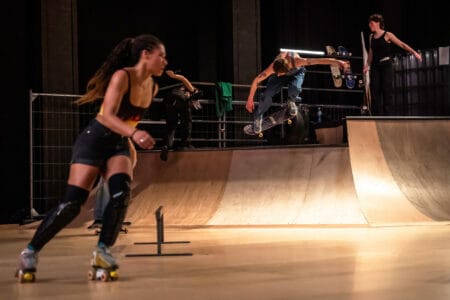
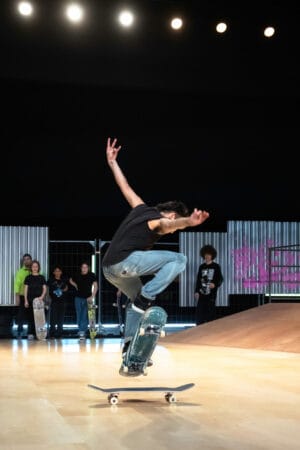
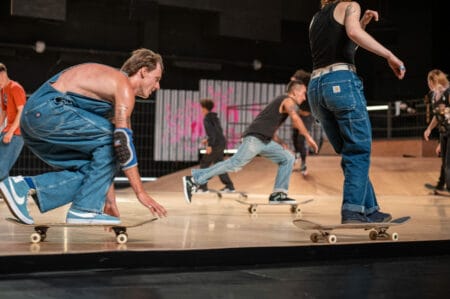
In Skatepark the stage is transformed into a vibrant skate ramp, and skateboarding into a strange choreography. Suddenly we all become part of a frenetic universe where skaters, rollerbladers and dancers try out tricks, start a band, sing, play games and play basketball. A community emerges - not through words, but through movement.
The stage space opens up to what happens every day in parks and streets: making something out of nothing. The ramp brings together different generations and groups. A community based on equal parts frivolity and hard work, teamwork and competition.
Mette Ingvartsen has skaters and dancers share a room - not to emulate each other, but to meet in what they already have in common: the body, the rehearsal, the persistence. It is not a performance. It is an ongoing movement built on presence and respect.
When the doors to the stage area open, you will initially meet local skaters demonstrating their tricks on the ramps on stage.
The ramp itself was designed by French company Antidote Skateparks, which specialises in building skateparks in public spaces.
Mette Ingvartsen on SKATEPARK
"A couple of years ago I was sitting in a skatepark in the centre of Brussels. As I watched the activity there, it began to strike me how incredibly performative this site was. I saw that it was both a space of virtuosic physical experimentation, and a shared, public place for cross-cultural encounters between communities. From my seat, I witnessed young people of different ages gliding through the park as they tried again and again to pull off spectacular tricks. I saw boys fly through the air on bikes or pedal quickly forwards with a single wheel touching the ground. I stared at a group of teenage girls rehearsing a dance they were recording on a mobile phone. I was blown away by their sense of rhythm, their total commitment, but also the fun they were having with each other as they perfected their dance before the camera.
It struck me how extreme the physical activity in this park really was. I was compelled by the persistence of these young people who were working so hard to succeed. It reminded me of practicing dance, and of how bodies can be driven by an insatiable desire to accomplish a specific movement. I was intrigued by their physical energy, but also by their capacity to coordinate themselves, and the respect they showed for the logic of movement needed to prevent accidents in their shared space.
In the following weeks I returned to the park to confirm the feeling I'd had, and with it the idea that a skatepark would be an incredible space and context for choreography. What I had in mind was an expansive form of dance that would be both physically virtuosic and socially relevant. A determined attempt to understand a place where different cultures thrive alongside one another, even at a time when our society is struggling to overcome all kinds of inequality and discrimination."
In co-operation with the Swedish Skateboard Association
About Mette Ingvartsen
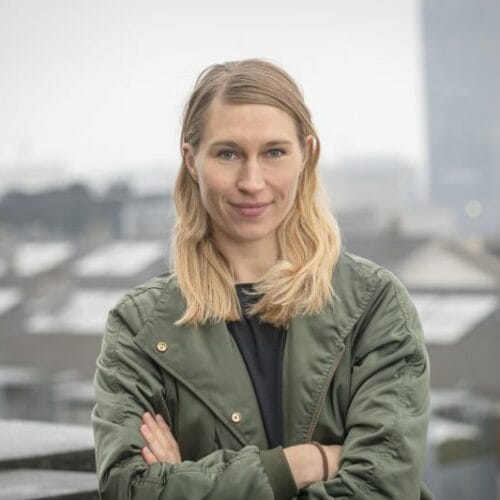
Danish choreographer and dancer Mette Ingvartsen has been a pioneer over the years with her works that move in different contexts around the body, technology and social criticism. She has previously shown several works on Dansens Hus stages, including "To come (extended)" (2018) and "Moving in concert" (2020).
Mette Ingvartsen studied in Amsterdam and Brussels and graduated in 2004 from the P.A.R.T.S. school in Brussels. Her earliest works were '50/50' (2004), 'Why we love action' (2006) and 'Giant City' (2009).
Between 2009 and 2012, she developed The Artificial Nature Series, a series of works that renegotiate the relationship between human and non-human presence on stage. This includes works without people - such as evaporated landscapes (2009) - as well as performances in which the body reappears, such as Speculations (2011) and The Artificial Nature Project (2012). In 2014, Mette started a series of works under the collective name "The Red Pieces". The first piece was "69 Positions", which questioned the boundary between private and public space by literally placing a naked body in the middle of the theatre audience. The second piece in the series was "7 Pleasures" where a group of 12 dancers explored variations of nudity and sexuality and concepts such as pleasure and lust; how the mass is set against the individual and the object against its own body.
In autumn 2019, Mette Ingvartsen premiered 'Moving in Concert' - a work in which she discusses the human being and its role in a new digitised world. In 2021, she presented two new projects: The Life Work, created in collaboration with elderly people in the Ruhr area in Germany, and the solo The Dancing Public, inspired by historical dance epidemics - which was shown at Dansens Hus Elverket 2022.
Between 2013 and 2016 Mette worked at Kaaitheater in Brussels. She has also been linked to academia and holds a PhD in choreography from UNIARTS. Over the years she has collaborated with Xavier Le Roy, Bojana Cvejic and Boris Charmatz, among others, and co-founded the artistic research collective EVERYBODYS.
After the performance SKATEPARK, choreographer Mette Ingvartsen will talk to BamBam Frost, artist and choreographer.
Concept and choreography
Mette Ingvartsen
Med
Damien Delsaux, Manuel Faust, Aline Boas, Mary Pop Wheels, Sam Gelis, Fouad Nafili, Júlia Rúbies Subirós, Thomas Bîrzan, Briek Neuckermans, Indreas Kifleyesus, Arthur Vannes, Camille Gecchele, Mathias Thiers, Bob Aertsen, Bo Huyghebaert, Nona De Neve and local actors from Stockholm.
Local skaters
Fricis Strauss, Alvar Carlén Wadsted, Jamilie Kroschel, Veronica Brohoff, Elian Canales, Viktor Soudy Castro, Data Minadze, Jim Nunez
Sound design
Anne van de Star, Peter Lenaerts
Light design
Minna Tiikkainen
Music
Felix Kubin, Mord Records, Why the eye, sonaBLAST! Records, Rrose, The Fanny Pads, Restive Plaggona
Dramaturgy
Bojana Cvejić
Costume
Jennifer Defays
Set design
Pierre Jambé/Antidote
Technical design set
Mr Stéphane Thonnard
Construction
Construction workshop of Théâtre National Bruxelles: Joachim Pochet, Joachim Hesse, Pierre Jardon, Yves Philippaerts, Andrea Messana, Boyd Gates
Technical Manager
Hans Meijer
Sound engineer
Milan Van Doren, Yrjänä Rankka, Filip Vilhelmsson
Lighting technician
Bennert Vancottem, Jan-Simon De Lille
Assistant choreographer
Jacob Ingram-Dodd
Co-production
La Danse en grande forme (Cndc - Angers, Malandain Ballet Biarritz, La Manufacture CDCN Nouvelle-Aquitaine Bordeaux - La Rochelle, CCN de Caen en Normandie, L'échangeur - CDCN Hauts-de-France, CCN2 - Grenoble, La Briqueterie - CDCN du Val de Marne, CCN - Ballet national de Marseille, CCN de Nantes, CCN d'Orléans, Atelier de Paris / CDCN, Le Gymnase CDCN Roubaix - Hauts-de-France, La Place de La Danse - CDCN Toulouse - Occitanie, La MC2 - Grenoble), Ruhrtriennale, Wiener Festwochen & Tanzquartier Wien, La Villette & Théâtre Chaillot, deSingel, Kaaitheater & Théâtre National Wallonie-Bruxelles, Kunstencentrum VIERNULVIER, Next Festival, Charleroi danse centre chorégraphique de Wallonie - Bruxelles, Theater Rotterdam, Perpodium
With the support of
Fondation d'entreprise Hermès, Wilhelm Hansen Fonden Residens: Rosas, Charleroi danse centre chorégraphique de Wallonie - Bruxelles, deSingel
Great Investment is supported by
The Flemish Authorities, The Flemish Community Commission (VGC), Tax Shelter of the Belgian Federal Government & The Danish Arts Council.